



![[United Kingdom]](images/flags/United Kingdom.gif "United Kingdom")
 Re: Newbie Questions - Getting an ACF
No, they're both likely to be Xenopus laevis, which has several different colour forms.Originally Posted by victrolatim

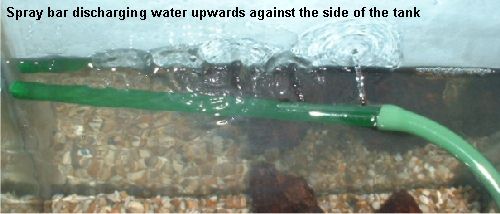
It's hard to say. The frogs have sensory organs that detect movement in the water so it's best to restrict water turbulence to a minimum to limit the risk of causing them distress. One way of achieving that is by connecting a spray bar that discharges water upwards against the back or side of the tank.
It's probably worth reading through these old threads where the topic was discussed in detail. Conflicting opinions on many husbandry aspects are quite common because there's very rarely only one right way to do things. What works for one person may not work for another.
- http://www.frogforum.net/showthread....Sand-Questions
- http://www.frogforum.net/showthread....-aquarium-deco
- http://www.frogforum.net/showthread....to-sand-a-pain
I doubt there's much risk of the frogs injuring themselves on rocks unless they're suddenly spooked and start panicking. The vinegar test you've read about probably refers to testing the calcium content of the rocks, which is important for some fish in terms of pH and water hardness. It's not relevant for the frogs.
Around 10 to 12 months usually.
It would be best to locate the tank in a low traffic area to minimise the risk of the frogs getting stressed. Be sure to provide them with shelters for refuge. The only noise likely to disturb you is if and when they start vocalising. They sound like this: https://www.youtube.com/watch?v=DHOBFbgjMKI
They do interact with each other but I wouldn't describe them as social animals or bestow them with anthropomorphic traits. A solitary frog will not suffer but you'll probably find it more interesting to have two, which your tank should accommodate comfortably.
Finally, they do not need a heater if the tank's at room temperature.

 Reply With Quote
![[United States]](images/flags/United States.gif "United States")

