


![[United States]](images/flags/United States.gif "United States")
 How to Keep and Breed Feeder Roaches
For ease of reading: Post #1 is general background info, Post #2 is a Care Guide, and Post #3 will be miscellaneous, FAQ, pictures, etc.
I've decided to make a little "how-to" guide for keeping and breeding species of feeder roaches effectively and for maximal production. With their gaining popularity as a species of feeder, I figure it will be nice to have a good resource to refer to for rearing these guys. Hopefully this will answer the most common questions people have about roaches. I want to emphasize that this is thread is going to be very thorough, and may seem overwhelming. Do not be discouraged by the length of this article: Roaches only need a bin, hides, warmth, food, and hydration to thrive.
The same strategies for rearing roaches can be used to effectively keep CRICKETS as well. However, crickets need a slightly more specialized setup to actually breed which I will not discuss in this thread. This thread is for the care and breeding of roaches.
Introduction to Roaches as Feeder Insects:
Feeder roaches have been dubbed the best feeder insects in the herp world by many, and with good reason too. They're becoming more readily available, and they have a variety of benefits over other feeders (from nutritional, cost, and maintenance aspects). I'll address some pros and cons of feeder roaches when compared to common feeders such as crickets.
First, I'd like to address that most of the species I will discuss will NOT infest your home. It's a fact that only a fraction of the cockroach species around the world are considered "pests." These guys are passive decomposers in nature, and those listed in the feeder industry hail from tropical climates (typically) that require heat and some other factors to encourage reproduction.
PROS:
-Very easy to keep and breed; low maintenance
-Do not jump
-Do not make noise/chirp
-Do not smell (50 crickets smell worse in a week's time than 5000 roaches in a year's time)
- Very high meat : shell ratio and very high Protein : Fat ratio
-Very Hardy, live substantially longer than crickets
-Variety of sizes in the colony, and a variety of species to choose from for individual needs
-When a colony is established, may never need to buy other feeders again
-Many more benefits I'm probably forgetting....
Check out this Nutritional Analysis of feeder roaches compared to other common feeders. Roaches are far superior on a nutritional aspect.
CONS:
-Expensive initial investment (compared to more common feeders)
-Takes some time to establish a colony
-Typically need to order online, or purchase from specialty shops and expos
-Some species are better suited to individual needs; most species are reclusive and will readily hide when in the herp's environment. Some "play dead" and refuse to move for long periods of time, some can burrow, and others may be too fast for some herps. [Species dependent]
-Some species can climb smooth surfaces such as glass (I'll elaborate on species soon)
-General fear in the human population (I was running out of cons)
I've kept and at least attempted to breed virtually every species of feeder insect available in the trade over the last decade and I can say with confidence that roaches are by far my favorite feeder. I purchased my first colony about 6yrs ago, and have not paid a penny for feeders in the last 4-5yrs once my colony became established. I've even made money back on the initial investment by selling off surplus roaches!
List of Common Feeder Roaches:
I'll now tend to the common species seen in the trade that are most readily available as feeders. There are many that make for ideal feeder species; but I'll go ahead and name a common few. None of these species can fly that I will list, even if the adults have wings. I will note in brackets and green font which species are capable of climbing smooth surfaces (such as glass). I will note in blue which species lay ootheca / egg cases. Again, ALL SPECIES LISTED ARE LIVE-BEARING AND DO NOT CLIMB OR FLY UNLESS STATED!
Medium/Large species. While nymphs can be fed to very small herps, these species grow large enough to feed larger reptiles. They also reproduce slower than the smaller species (typically).
- Blaptica dubia - Guyana Orange Spotted Roach
- Blaberus discoidalis - Discoid Roach / False Death Head Roach [ALLOWED IN FLORIDA]
- Blaberus fusca - Dwarf Cave Roach
- Blaberus fusca hybrids
- Eublaberus posticus - Orange Head Roach
- Gromphadorhina portentosa - Madagascar Hissing Roach [Climbing Species] [MALES ALLOWED IN FLORIDA]
Smaller/More Prolific Species
- Shelfordella (Blatta) lateralis - Turkistan Roach / Red Runners [Lay Egg Cases]
- Naophoeta cinerea - Lobster Roach [Climbing Species] *
- Blatta orientalis - Oriental Roach [Lay Egg Cases] [Climbing Species]
- Others less readily available.
*Lobster Roaches are a noted infestation species due to their ability to reproduce at room temperature. Very rare and highly unlikely, but worth noting.
It's my experience that those species that lay egg cases are more prolific than those who are live bearing, but conditions have to be just right in order to ensure the ootheca hatch out and do not dry out. The live-bearing species tend to be effortless to breed, as they incubate within the mother's body.
Specific Species Profiles - B. dubia , Turkistan Roaches, Orange Heads, and Lobster Roaches
If you would like more information about any of the other species listed ( or not listed) feel free to ask away! I can provide my own experience with a number of these roaches, and will gladly point you in the direction of where to obtain more information about the species as well as suppliers. We also have a variety of members in the forums who keep roaches that would be more than willing to help!
- Blaptica dubia AKA Guyana Orange Spotted Roach (dubia's)
B. dubia roaches are the most popular species in the feeder world. They range in size from about 1/8" when born to approximately 2.5" as adults. Depending on their care, they can reach sexual maturity within about 5 months and females can live anywhere from 12-24 months, producing approximately 20-30 live babies every month. Males have wings but cannot fly (only flutter fall) and females lack obvious wings. I will address the care for this species in in the specific CARE section of the thread due to their overwhelming popularity.
- Shelfordella (Blatta) lateralis - Turkistan Roach / Red Runners
Turkistan roaches are great cricket replacements; they attain approx. the same size as the domestic cricket both when born and into adulthood. This species lays egg cases (ootheca), and reproduce very quickly compared to many other species; laying 1-2 cases per month, each containing 20-30 babies. Males have wings (but cannot fly, only flutter-fall) and females lack them. This species is relished by any herp that feeds by movement, they are an excellent cricket replacement: Fast moving, and have a tendency not to hide as readily as other species. I've found that this species does better with a substrate of soil, coir (coconut fiber/eco-earth), and/or leaf litter for best results in hatching ooths.
- Eublaberus posticus - Orange Head Roach
An awesome and often overlooked feeder roach species. These guys are even meatier than dubia, much more active, and still reproduce at just about the same rate! Nymphs are a beautiful red/maroon color and look like fat little tanks. They do have a mild defensive odor, but to me it only smells like overripe fruit. These are a favorite for the majority of my herps, and care for them is identical to that of B. dubia. That being said, do NOT keep this species with dubia or any other insect for that matter, as they will readily kill and consume others that are not their kind. They are known wing biters, and even cannibals in overcrowded/improper housing situations; but this can be remedied by lots of moisture in their diet and debatably slightly higher protein content. The key to keeping these guys is having a dish of water crystals or some moisture available at all times...one of my favorite roaches! Both males and females have wings, but neither can fly nor climb.
- Nauphoeta cinerea - Lobster Roach
If you are looking for a cheap and prolific cricket replacement, look no further! Lobster roaches (sometimes refered to as 'Woodies' or 'speckled roaches' in some parts of the world) are one of the fastest reproducing roaches money can buy. They attain an adult size of about 1.5" in length, and both adult males and females have wings but cannot fly. These guys easily crank out upwards to 30 nymphs monthly in ideal conditions, and are live-bearers. Lobster roaches are capable of reproducing at much lower temperatures than the other species listed, and it is worth noting that there have been documented infestations with them (although this is rare). This is a smellier roach than others and will need cleaning more frequently to control odor, and they are also capable of climbing glass and smooth surfaces. Be sure to apply a thin layer of petroleum jelly/vaseline across the upper rim of your bin in ~1" band to ensure they cannot escape.
--A note on growth: Roaches grow in size by molting and shedding their skin. During this time, the roach will appear white in color and is very soft bodied and vulnerable. If you happen across a molting roach, leave it alone to allow it to finish hardening its exoskeleton...Or you can feed it off to your herp as a soft, tasty treat!
Last edited by JeffreH; June 30th, 2012 at 12:14 PM.
-Jeff Howell
ReptileBoards ( Branched from The Reptile Rooms )
"If you give, you begin to live." -DMB
Re: How to Keep and Breed Feeder Roaches
Care, Keeping, and Breeding Feeder Roaches:
Time for the good stuff - how to properly care for feeder roaches.
Alright, so you have made the decision to keep and breed roaches, now it's time to get them properly set up and cared for to ensure a prolific breeding colony that also doubles as a a great food source for your insectivores. I'll address care in "steps"
Choosing a Species and Quantity to get started with
- I won't go into excessive detail about this, feel free to ask away in this thread or in the forum what species is best to accommodate your individual needs. It's simply too difficult to provide all of the variables in one post...and I feel this informational thread is already quite excessive!
HOUSING AND CARING FOR ROACHES
Roaches need only a few things to thrive: a bin, hides, food, hydration, and warmth.
-Selecting a Bin or Container to keep them in:
- I prefer using plastic storage bins for housing roaches, preferably the opaque kind as roaches are shy creatures that thrive best in darkness. I avoid aquariums due to their size, cost, and the fact that many species can readily climb the silicone in the corners of aquaria. Avoid the rugged type of plastic bins, be sure to get non-textured very smooth plastic (Sterilite brand, for example). This is to ensure that baby nymphs cannot climb the sides of the bin. A 10-gallon storage tote can house 1-2 thousand mixed roaches (typically) if there is an adequate amount of egg flats.
-Ventilation for your Bin
- I usually cut out a section out of the the lid of my bin, and secure aluminum mesh or windowscreen for ventilation. I'll provide a picture of this and a complete setup in my next post along with many other pictures. Depending on the size of the bin, I usually cut out a 5" x 5" square...give or take. I prefer to screen more of the bin if possible as you can always cover it up later if things are too dry or less ventilation is required.
- Humidity
- I generally do not measure the humidity in my bins, but most roaches fare well at roughly 50% humidity. If things are too dry, roaches will be unable to molt properly. If the humidity is too excessive, you will note molting issues, hypopigmentation, and increased bacterial and mold potential. The bin should never be allowed to form condensation on the sides (for these feeder species). If things are too dry, decrease ventialtion and increase the amount of water crystals available at all times. If they are too damp, increase ventilation and lower frequency of feeding salad items and water crystals.
-Heat & Temperature
- Roaches need a heat source to thrive and breed properly. This is most easily accomplished by using an Undertank Heater (UTH) or Flexwatt Heat Tape; although heat lamps pointed at the bin can certainly work as well. The bin will rest on the heat source, and temperatures in the bin should generally be anywhere from 85-95 degrees F for ideal growth and reproduction for most species. This is a very general value measured immediately on the surface of the bin above the heat source... all species have slightly different needs; but in general this range will allow most species to thrive quite well. If you are unsure about your roaches or would like to clarify temperatures, just ask! Be sure to wire and mount Heat Tape safely, here is a Heat Tape Mounting Guide tutorial by Pro Exotics.
-Hides/Climbing Structures
- Roaches require hiding spots to feel secure, in addition, these hiding spots will double-up to increase the surface area of the bin and allow you to fit significantly more roaches in the area. The best hiding structure in my opinion is Egg Flats, the 'cardboard' or recycled pulp kind. You can also use Drink Carriers from fast food joints, and even toilet paper or paper towel rolls (not as efficient for larger colonies). Stack these structures VERTICALLY - this allows the frass (poop) and shed skins to fall down to the bottom of the bin. It also allows more roaches to utilize both sides of the flats, which means more roaches can squeeze happily into a smaller space.
-Food/ Gutloading (Dry Feed)
- Roaches will readily consume a variety of dry foods. There is some speculation that roaches tend to crave higher protein diets. I personally use a combination of Chick Starter [non-medicated], quality dog and cat kibble, fish food and other baby cereal grains. I have dry feed available to my roaches at all times. No need to grind up the food, roaches are fantastic decomposers and will be able to consume even larger kibble.
-Hydration (Moisture source: Veggies, Water Crystals, etc)
- An ample amount of moisture is needed in the diet to properly hydrate roaches, as the content in most dry feeds isn't substantial enough. I keep a dish of Water Crystals available at all times for my roaches. I also utilize salad items such as dark leafy greens, veggies, and some fruits for moisture (you can use these explicitly, if you'd like). I generally throw some salad items on top of the roaches a couple of times per week to supplement their diet, provide another moisture source, and to increase nutritional benefits as feeders.
Substrate (Bedding) and Cleaning
- Most species of roach do not need a substrate to thrive, although a few species do prefer a couple of inches of oak leaves, coir, etc. The species I have listed do NOT require a substrate to thrive, and you can simply keep the bottom of the bin bare. For egg laying species, I do recommend an inch or two of substrate to help hold humidity and prevent ooths from drying out (i.e. Turkistan Roaches).
- Cleaning: Roaches essentially make their own substrate over time by the accumulation of frass and shed skins on the bottom of the bin. This is perfectly sterile, and generally has no significant odor. I allow the frass of B. dubia to accumulate to a couple of inches before actually cleaning... I've let bins go for months at a time without cleaning with no noticeable smell or issues to the colony.
-Breeding:
- Under these conditions, roaches will thrive and reproduce on their own. No extra effort is necessary. The rate of reproduction and growth depends on the species, quantity of roaches, and care factors. If you keep your roaches warm, comfortable, and well fed, they will reproduce. Live-bearing species will be producing litters as frequently as possible and you'll find ooths littered everywhere before you know it for those egg layers!
- Male : Female Ratio. I think the ideal Male to female ratio is approximately 1 male for every 3-5 females. Feel free to cull excess males if you have too many (keep em, feed them, sell em, squash em...whatever floats your boat). I've heard of ratios as high as 1male to 1 dozen females as well with success.
- Females of most species will produce offspring for the majority of their lives; and many species live a LONG time compared to crickets and other feeders. Female B. dubia, for example, may live for anywhere from 12-18 months after reaching sexual maturity. Considering they often produce litters of ~25 every month or so, that's a phenomenal quantity of offspring over the course of their lives to contribute to the growth of the colony.
-Jeff Howell
ReptileBoards ( Branched from The Reptile Rooms )
"If you give, you begin to live." -DMB
Re: How to Keep and Breed Feeder Roaches
I'll reserve this post for future editing of pictures and a brief FAQ section. I'll provide pictures of the various species mentioned, comparisons, bin setup, etc. I need some time to resize all of the images.
http://i2.photobucket.com/albums/y33...H/DSC07515.jpg
I thought this would be a nice additional to FrogForum seeing as we have an increasing number of members with questions about roaches. I wrote this article up last Autumn on my website... not sure if the forum rules will allow me to link to the original source so feel free to PM me for the original copy.
Let me know what you guys think! Hope this helpful! I apologize for the length... It's a pretty excruciating read but roaches have been a hobby of mine for years and I just love to write about em = )
Not sure if this would qualify for a caresheet submission, or where I may go about doing that? Also, what are the picture limits per post?
FAQ-esque Section
Can I Keep small nymphs with adults?
- Yes. As long as proper care is provided, you can keep a mixed colony. This is what makes roaches even easier to culture than other feeders, you only need one bin! If you would like to sort sizes or separate your roaches from frass, check out this thread: http://www.frogforum.net/food-feeder...tml#post112361
Can I mix different species of roach in a single bin?
- It depends on the species, but most roaches are generally best kept with their own kind. There are a variety of problems that may arise from mixing species: cannibalism, lower production due to mixing of pheromones and competition, and potential hybridization of same-genus roaches. It is always best to raise each species in its own bin with its own kind.
Legality of Roaches
- Feeder roaches are legal to keep in much of the US, wih Florida being the major exception. Florida state laws do not allow most of the common feeder roaches to be brought into the state. The following species are allowed in Florida:
Blaberus discoidalis
Blaberus craniifer
Eurycotis floridana
Panchlora nivea
MALE Gromphadorhina portentosa
Pynoscelus surinamensis
It is worth noting that Blaptica dubia are not allowed in the state of Florida. A good dubia replacement would be the False Death Head roach, AKA "Discoids" (Blaberus discoidalis). They require similar care to dubia and reproduce at roughly the same rate, but attain a larger size and are not sexually dimorphic (both male and female adults have wings but cannot fly). I unfortunately know very little about international laws but I'm familiar with people all around the world that culture roaches as a hobby.
Allergies
- I was cleaning some bins and recalled something fairly important to discuss, allergies and dermal irritation. A SMALL fraction of people (myself included) will find that some species cause allergic reactions to the frass and proteins in the shed skins of some species. This is most commonly attributed to Blaptica dubia and G. portentosa (Madagascar Hissers). I often experience watery eyes, running nose, sneezing, etc when doing bin cleanings. Day-to-day feeding and handling does not not cause any issues for me, but when the whole thing gets stirred up it gets a little uncomfortable. This is a rare phenomina, so don't be discouraged. Besides - I keep thousands of these guys, a variety of species, and I don't let it get to me... the benefits simply outweigh this minor issue. A mask sometimes helps.
-Dermal irritation - many species, particularly the larger species, do have small barbs on their legs that can "scratch" you while handling. For those of us with easily irritated skin, this can leave small, red bumps that can itch (rash-like). The same thing can happen with larger crickets and locusts... But: roaches do NOT bite. I've tried desperately to provoke biting in a majority of species, most simply opt to bunker down and remain defense rather than set up on an aggressive response. Often, washing your hands will remedy the issue. Some people opt to wear latex gloves for handling or use feeding tongs.
WTF are those little fuzzy worms and beetles in my Roach and Cricket orders!!!
- I've seen this asked a few times, and its a much more common occurance in cricket orders from large scale breeders. These are a species of Dermestid beetle and their larva (yes, the same kind of bugs that clean animal remains). These guys will not harm your roach colony, or you. They are commonly placed in insect bins to help clear the remains of deceased insects and skins, essentially keeping hte bin cleaner. You can fel free to remove them, kill them, or let them stay in the colony with no negative effects.
Do not Disturb
- Roaches in general are quite reclusive and shy creatures, they don't like to be disturbed often. You will have best results breeding if you provide ample food and moisture to last several days, and only open their bin to replace feed and water crystals/salad items when necessary. Try to avoid messing around with the roaches every day (or several times a day, for that matter) for best results. Spooking the roaches can sometimes lead to prematurely dropped ootheca. If husbandry is ideal, leave em alone and the colony with take off.
Overcrowding
- Yep, roaches can become cramped... A tell-tale signs of overcrowding include, but are not limited to:
-Unusually small adults
-Roaches unable to hide when distrubed, heavy numbers visible in the open
-Unusually high food and moisture needs. If you are always running out of food and moisture, despite having fairly large dishes, annd the roaches always come running like their starving upon adding more food and drink, odds are there are too many in that bin.
-Heavy wing biting (also a sign of lack of hydration/food)
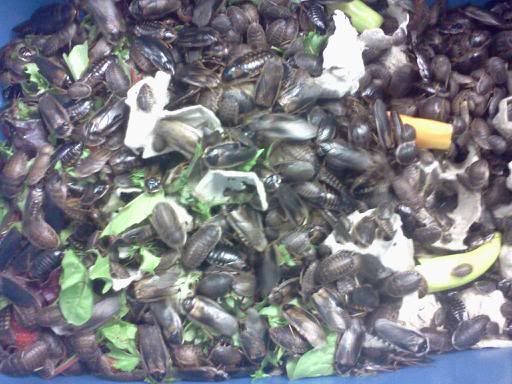
Some species actually prefer being crammed together, though. I've found that B. fusca, G. portentosa, and B. dubia all don't mind being essentially on top of one another and still breed like crazy. Other species, particularly E. posticus, prefer a little wiggle room. Example of an overcrowded B. dubia colony:
Patience <--IMPORTANT
- Roaches don't explode into an instant colony as soon as you bring them home (unless you buy a very large, established colony off the get-go). There are a number of strategies you can employ to get yourself a sustainable colony that can recover from being fed out of. I'll address these questions by those of my most common customers, bearded dragon owners:
1) Get a colony established before getting the animal. If your in the research process and know you want a dragon/lizard, get your roaches now and get the colony going. The sooner you get them set up, the sooner the colony will be able to take hold.
2) Drop some $$$. If you want your colony to be ready for your reptile sooner, spend the extra money on larger populations and larger nymphs. Let's say you want to have enough B. dubia to raise a baby bearded dragon who consumes massive quantities of insects; you'll likely want at least 100-150 adult breeding females, appropirate mix of males, and a very large quantity of nymphs to feed and to replace breeders in the colony. Quantites like this cost a lot of money, but keep in mind this colony may sustain your dragon for the rest of his life... sure beats the heck out of spending $15-20 on crickets every week or two.
3) Buy babies in bulk. If you are patient, have a lot of mouths to feed, and don't have as much cash... buying smaller nymphs in bulk is the most economical option. You can usually order twice the quantity of small nymphs for the same price as a mixed set of nymphs. Give them time to reach maturity, and you'll be swimming in roaches shorlty there-after.
4) Most typical method: buy mixed sizes of nymphs in a fairly standard quantity (100, 250, or 500). Depending on your individual needs, allow these to become established for a couple of months before feeding heavely out of the colony. This varies greatly on an individual basis depending on the species, quanity of herps, and your time frame/budget. Feel free to ask specific questions about quanities and species of roaches best for your situation and goals.
Moral of the story - roaches take some time. Always allow your colony to become well established before feeding out of the colony. Its always better to have more roaches than not enough! Good rule of thumb, when you think you have enough... give them another month or two before you really begin feeding out of the colony. It seems like a long wait, but its well worth it. Keep in mind you are preparing yourself to have a sustainable food source that can last years with proper preparation; its an investment.
Last edited by JeffreH; June 30th, 2012 at 12:13 PM.
-Jeff Howell
ReptileBoards ( Branched from The Reptile Rooms )
"If you give, you begin to live." -DMB

 Re: How to Keep and Breed Feeder Roaches
Great read and info..........
Re: How to Keep and Breed Feeder Roaches
Excellent read and info Jeff!
Yesterday, i bought 600 mixed wood roaches and when i put the food in, they swarmed around it went crazy!
They are great, can't wait to get my frogs through!
Re: How to Keep and Breed Feeder Roaches
Great thread with good info!
Just want to point out that this forum apperantly changes 'WTF' to 'White's Tree Frog' so you ended up with this little confusing sentance in the third post "Whites Tree Frog are those little fuzzy worms and beetles in my Roach and Cricket orders!!!"
Re: How to Keep and Breed Feeder Roaches
what brand of water crystals should I be looking for? I am currently using flukers calcium water gel, but I was reading in another forum that calcium used long term can cause improper molts.
Re: How to Keep and Breed Feeder Roaches
Thank you for the kind words everyone = )
Raya: Lol! Thank you for noticing that... it appears the forum changes W T F to White's Tree Frog ; ) But it appears that I am unable to edit my posts at this point. = P
arielgasca420: I prefer ordering dry crystals - you get a lot more bang for your buck that way. One dry ounce of water crystals will make roughly one gallon of prepared water gel (just add water) and a single ounce typically costs ~$1 from most online retailers.
Dry Crystals:
Prepared Gel:
The stuff from Garden Centers may work, but I have never personally used it nor do I know what exactly the composition of the crystals are. I'm also not a fan of the Fluker's stuff; kind of a personal bias against the company for a blatant disregard for the well-being of animals at their own facilities.
I bought my crystals from Aaron Pauling at: Aaron Pauling.com . Most feeder roach suppliers have water crystals for sale... Greg's Exotic Inverts, West Coast Roaches, etc. You may also be able to find seller's on private classified listings such as on Kingsnake.com or via a search on something like "Water crystals for feeders" or something to that nature.
-Jeff Howell
ReptileBoards ( Branched from The Reptile Rooms )
"If you give, you begin to live." -DMB
Re: How to Keep and Breed Feeder Roaches
Great information! I have raised hissers for years and just bought 100 dubia's at the last expo. I am a convert! lol. I hate cricket's. The con's to cricket's out way the good for me at this point. Of course, all of my animals love the roaches as well! Thanks for saving me the research time on exactly what I needed to start raising my newest feeders.
Re: How to Keep and Breed Feeder Roaches
can I use non toxic polymer (acrylic polyacrylamide)
Re: How to Keep and Breed Feeder Roaches
very nice. i am thinking of buying a starter culture of dubia roaches. glad i read this and its going in my favorites so i can refer back to it. thank you very much for posting this.
Re: How to Keep and Breed Feeder Roaches
Hey Arielgasca420 - I did a little research on your acrylic polyacrylamide because it made me a bit nervous at first. I used to use polyacrylamide pretty frequently in the lab when running DNA digests and was instructed to be particularly cautious of the neurotoxic potential of the acrylamide gel. When depolymerized, acylamide is toxic.
Apparently, the polymer is safe. I've honestly never looked into what specifically the insect feeder gel is made of but it is probably the same thing = )
-Jeff Howell
ReptileBoards ( Branched from The Reptile Rooms )
"If you give, you begin to live." -DMB
Re: How to Keep and Breed Feeder Roaches
I just got finished reading your thread. Wow! That's a lot of info. My son has a pacman frog that is about 4-5 months old. Could you tell me about what size colony we would need of dubias?
There are currently 1 users browsing this thread. (0 members and 1 guests)
 Posting Permissions




 Reply With Quote

![[Sweden]](images/flags/Sweden.gif "Sweden")

